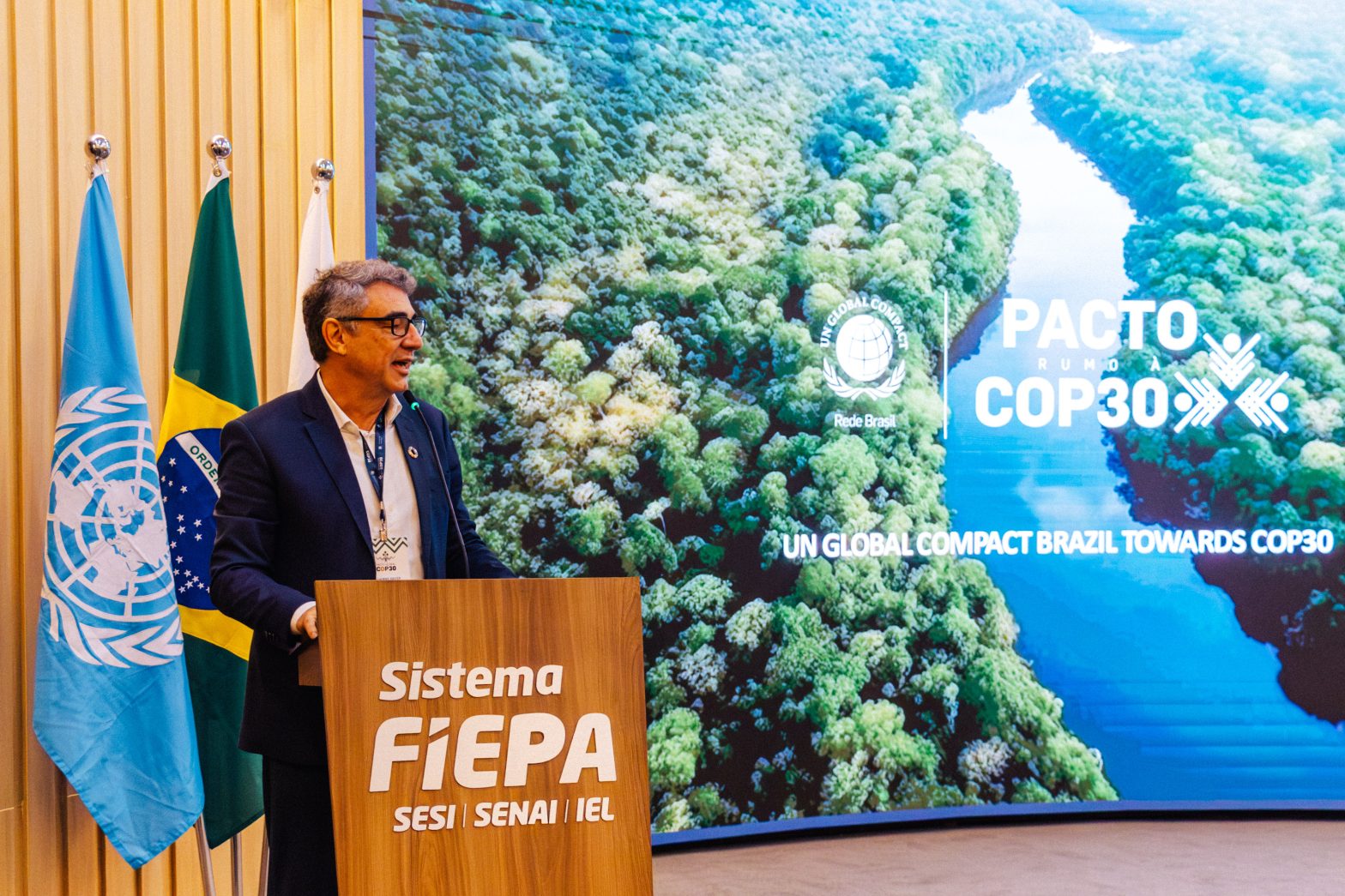
UN Global Compact Network Brazil was present in panels, meetings, technical debates, and side events that reinforced its cross-cutting role in the climate agenda and its function as a connector between companies, governments, science, and civil society. For Guilherme Xavier, Executive Director of the UN Global Compact – Brazil Network, COP30 marked a new stage of maturity for the business sector. “What we saw here was a private sector willing to take on responsibilities and deliver results. Brazilian companies have shown that they implement real solutions and are ready to act with greater ambition and scale,” he stated.
The first week brought together fundamental discussions on water resources, agriculture, the circular economy, the ocean, food system governance, and due diligence in the livestock sector. In these agendas, the Pact expanded its dialogue with companies, international institutions, and strategic partners, strengthening the convergence between climate policies and corporate practices. The sessions presented experiences that translate climate action into measurable results, such as regenerative agriculture projects, circular currency models, restoration of degraded areas and watersheds, and initiatives to expand access to basic sanitation.
Rubens Filho, Environmental Executive Manager of the UN Global Compact – Brazil Network, highlighted that “this moment showcased the collective effort of companies to present practical solutions. The deliverables we made here reflect continuous collaborative work with the private sector.” The Global Compact also launched three strategic publications that marked the conference: the report on biofuels and freight transport electrification, the Regenerative Agriculture Guide, and the Guide to Combating Ocean Plastic Waste. Developed throughout 2025 with the support of Brazilian companies, these documents expand the technical knowledge base and offer clear pathways for the implementation of environmental, social, and economic solutions.
In the second week, the “Pacto Rumo à COP30” program was highlighted at an event in the Blue Zone, where Danielly Mello Freire, Climate Manager, led the conversation and presented the initiative’s main advancements, reinforcing its collaborative nature. “It is a great pleasure to present the results of this project at COP. It was designed so that the journey towards this agenda would be comprehensive and in partnership with the private sector. I am very happy for this opportunity,” she said.
With concrete deliverables, knowledge production, and joint engagement with various sectors, the Pact reinforced its presence at COP30 by showing that implementation is the core of the climate agenda. More than just debates, the presence in Belém demonstrates that collective action, innovation, and shared responsibility are fundamental to accelerating the transformations that Brazil and the world need in the short term – and to building, with ambition and clarity, the next decade of solutions. In this context, an essential question remains: How can your company join this movement and amplify the impact of the solutions that the country is already building?