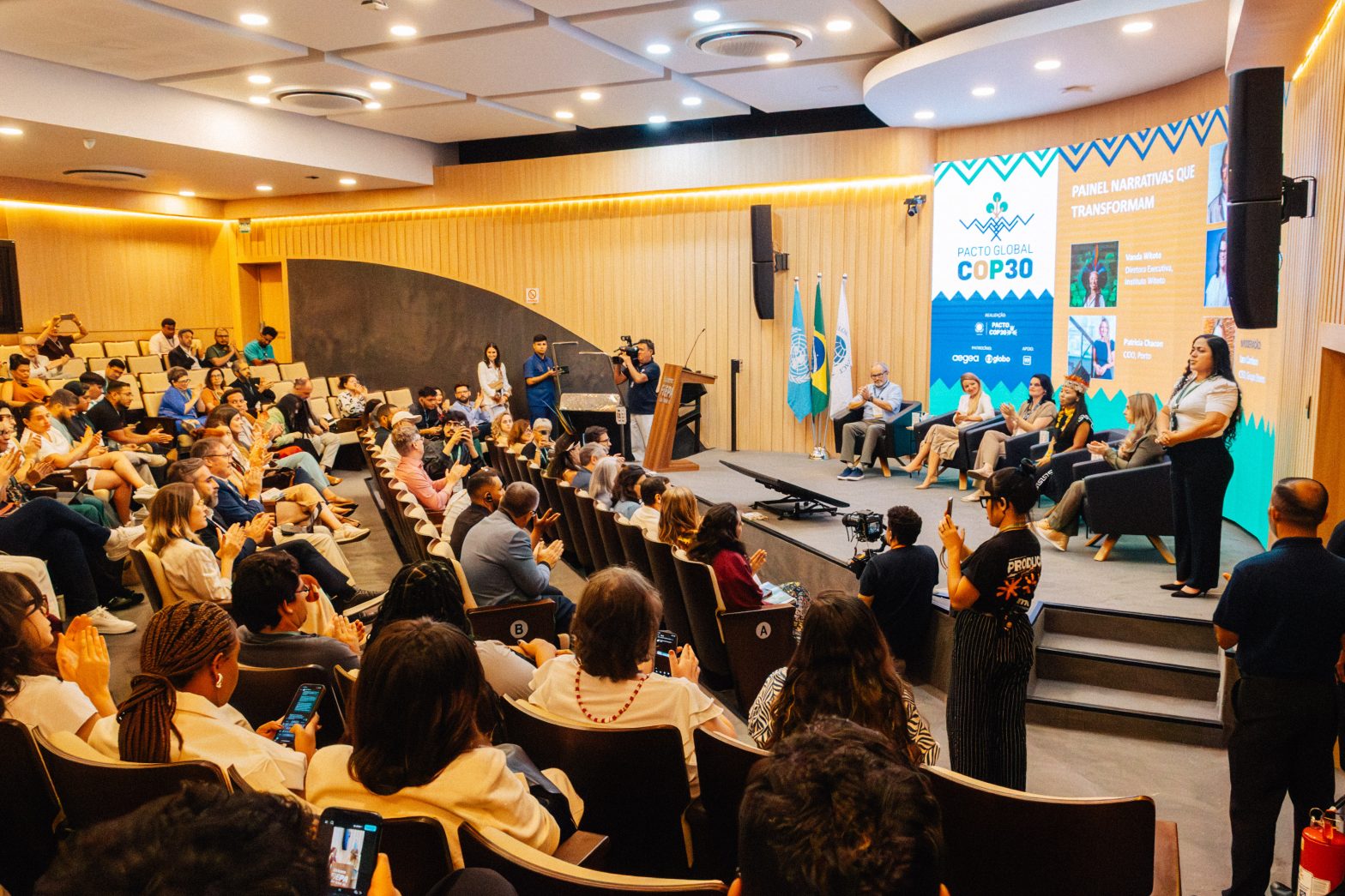
São Paulo, November 2025 – At the event “Beyond Belém: The Legacy of COP30,” held on Monday the 17th, global leaders, experts, and Amazonian representatives convened to discuss new ways of integrating nature, development, and corporate responsibility. The launch of the Nature and Climate Hub, a partnership between the UN Global Compact – Brazil Network and the Brazilian Ministry of Science, Technology, and Innovation, opened the floor for a debate on how companies can act with greater socio-environmental impact.
Guilherme Xavier, Executive Director of the UN Global Compact – Brazil Network, synthesized this role by stating that Belém “was not merely the host city of COP30; it was a choice laden with meaning,” citing technical consistency and alignment with the Amazon as decisive points for the lasting legacy.
The event gained depth with the address by UNFCCC PCCB Co-Chair, Princess Abze Djigma, who emphasized the need to recognize those who produce real solutions in their daily lives. She stated that “it is time to change the narrative about who produces solutions,” indicating that peoples and territories already possess knowledge capable of guiding policies and investments. Her vision outlined pathways for companies wishing to build strategies aligned with the reality of the territories and capable of creating economic value alongside preservation.
Navigator and researcher Tamara Klink broadened the debate by explaining how the ocean is absorbing heat at an accelerated rate and altering global climate stability. Her speech brought scientific clarity and reinforced that the time for efficient decisions is short. By reminding attendees that “this is the decisive decade,” she presented data and reflections to help the private sector understand risks, responsibilities, and opportunities for a sustainable transition.
A central question emerged from the gathering: Why does this event matter? Because it brought together science, companies, governments, and Amazonian communities around a single objective. This dialogue offered the private sector the chance to understand that the forest represents more than an environmental heritage; it is an economic frontier that depends on responsible decisions. By uniting technical knowledge, ancestral wisdom, and business vision, the event presented a concrete path for companies seeking to operate with credibility and relevance in the global climate scenario.
Next, Indigenous leader Vanda Witoto, Director of the Witoto Institute, brought a perspective that connected territory and development. She asserted that “speaking about climate is speaking about territory” and emphasized that no economic model is sustainable without the forest. By noting that land demarcation protects global climate balance, Vanda invited companies and the financial sector to strengthen initiatives created within the territories. Her speech demonstrated that productive collaboration between communities and private investment yields social, environmental, and economic results.
The closing was marked by a performance from Pará-born singer Zaynara, interpreter of “Sou do Norte” and “Quem Manda em Mim.” Her presence brought the cultural force that expresses the spirit of the Amazon, reminding everyone that identity, art, and belonging are also part of building climate solutions. The event concluded with a clear perception: transforming the relationship between nature and the economy is possible and begins with choices made now. The private sector has the opportunity to lead this new phase by recognizing the potential of the territories, adopting responsible practices, and supporting solutions created by those who live in the forest.
Sponsors: AEGEA, GLOBO, COCA-COLA
Support: GM