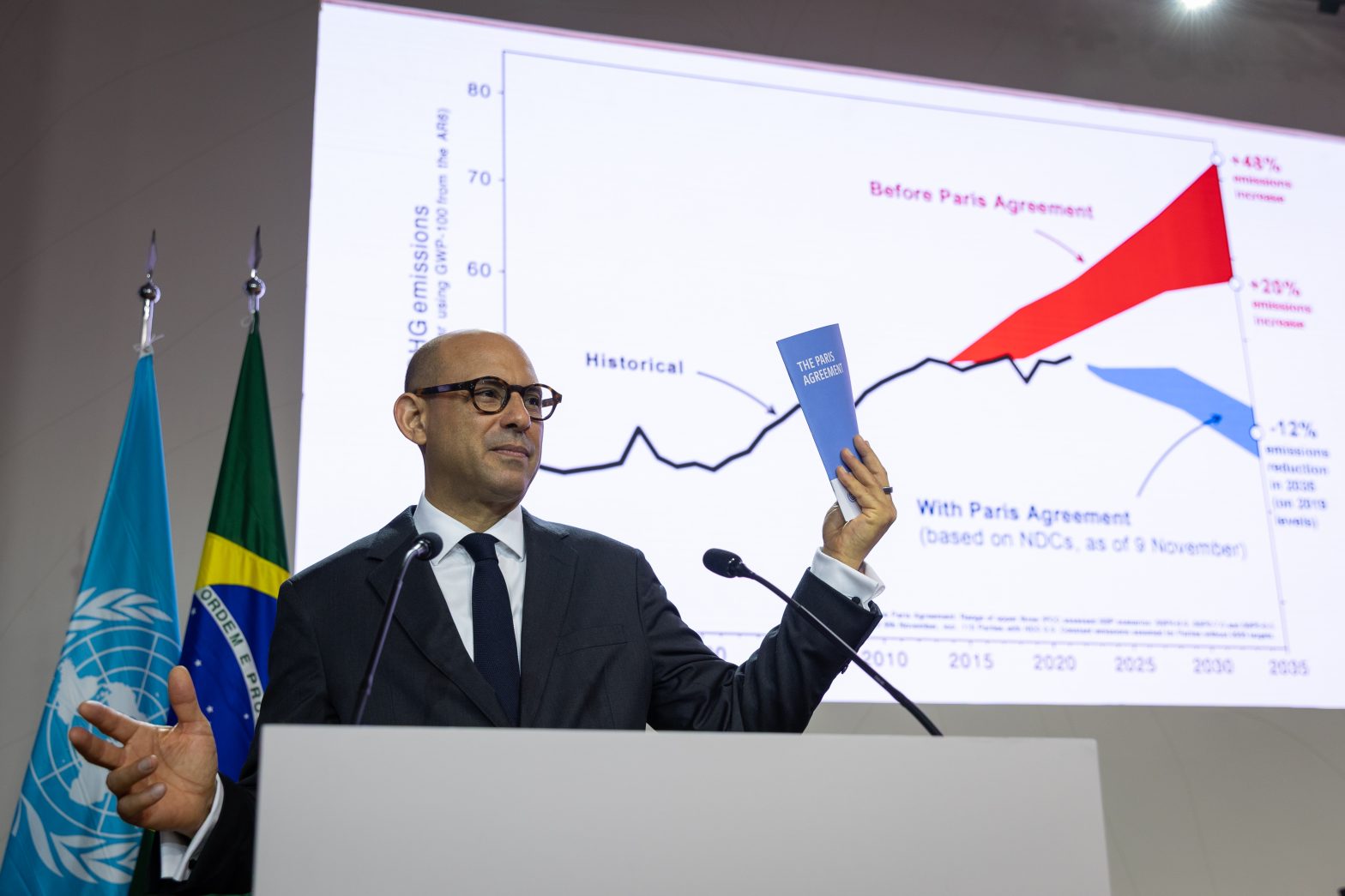
The plenary held today, November 19, at COP30, consolidated a central message for the world: the climate agenda has definitively entered the implementation phase. The meeting brought together High-Level Climate Champion Dan Ioschpe, COP30 CEO Ana Toni, and Simon Stiell, Executive Secretary of the UNFCCC, in a conversation that highlighted that climate progress depends on continuous action, collaboration between sectors, and decisions aligned with science. Simon reinforced that climate action means a stronger economy, more jobs, and more resilient societies, emphasizing that action agendas must be treated as investment pipelines and not as optional initiatives.
In the presidency’s reflection, Ana Toni drew attention to the importance of the coalitions built throughout the COP. She pointed out that the conferences bring together 198 countries, subnational governments, investors, the private sector, indigenous peoples, and civil society, and that convergence between these groups is essential to transform commitments into concrete results. Ana cited significant advances, such as the 1.7 billion reais allocated to indigenous peoples and the modernization of the healthcare system in Belém, a direct legacy of COP30. She also recalled that six priority themes were structured with the support of voluntary actors, forming a solid foundation to accelerate solutions.
Simon Stiell reinforced that climate action must occur 365 days a year and that this COP inaugurates five years of continuous global action. He highlighted the urgency of implementation and the need to share innovation across all sectors, ensuring that companies bring concrete results to the communities in which they operate. Dan Ioschpe emphasized that the new phase of the global climate agenda will be guided by science, inclusion, and the ability to turn ideas into solutions. He cited ongoing structural changes, such as billion-dollar investments in energy, grid modernization, and urban resilience initiatives driven by companies and philanthropic funds.
The continuation of the Global Climate Action Agenda for another 5 years was announced. Ioschpe stressed that this new era of implementation also aims to bring investors into the Agenda, turning ideas into solutions.
The Pacto Rumo à COP30 Program was selected to be part of the COP30 Presidency’s Action Agenda Solutions Warehouse, an official list that brings together initiatives considered exemplary for accelerating climate implementation worldwide. 123 actions from 27 countries were approved, including Argentina, Australia, Belgium, Brazil, Canada, Chile, Colombia, Costa Rica, Denmark, Egypt, France, Germany, Guatemala, India, Italy, Kenya, Mexico, the Netherlands, Nigeria, Peru, Portugal, Sweden, Switzerland, Turkey, the United Kingdom, the United States, and Vietnam.
This recognition confirms the importance of the work carried out by the Rede Brasil and reinforces the role of the Brazilian private sector as a protagonist in building climate action pathways integrated with the needs of people and the planet.