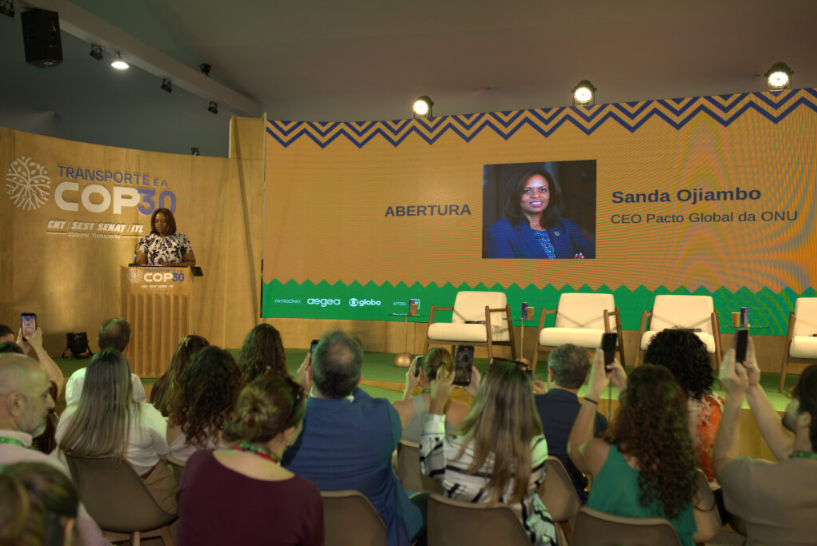
The UN Global Compact Network Brazil launched today, in the Green Zone of COP30 in Belém, the Business Guide to Combating Marine Litter, developed by the Blue Keepers program, alongside the Circular Currency prototype from the ReInova project. These initiatives are part of the Action Platform for Water, Ocean, and Waste and reinforce that tackling climate change requires collaboration among businesses, governments, and civil society. For the Brazilian Network of the Global Compact, acting for the climate means acting for ourselves, placing people at the center of decisions and the necessary transformations.
The initiatives demonstrate that preventing the improper disposal of waste and advancing the circular economy are feasible and already underway through new operating models and connections between companies and territories.
“The first side event of the UN Global Compact Network Brazil at COP30 was a success, with Sanda Ojiambo, Executive Director of the UN Global Compact, highlighting corporate action on water and waste. Ana Fontes detailed the platform’s deliverables, and companies shared the impact of their actions. The event emphasized the commitment to implementation, aligned with COP30. It was a day to present results, inspire, and renew partnerships for a sustainable future,” said Gabriela Otero, Manager of Water, Ocean, and Waste at the UN Global Compact Network Brazil.
During the panels, private sector representatives shared results from projects already in development. Katielle Haffner, Sustainability Director at Coca-Cola, highlighted the inauguration of one of the largest recycling plants in the Northern region, in Ananindeua, and the direct work with waste pickers. For her, the circular economy only works when it values people and the territory. The projects presented show that tackling climate change depends on strategic decisions, innovation, and social transformation.
By promoting debates and presenting initiatives during COP30, the UN Global Compact Network Brazil reinforces the private sector’s role in the climate agenda. The presence in Belém strengthens partnerships, expands knowledge exchange, and accelerates the implementation of sustainable solutions. The movement is already underway: connected companies generate real impact.